Rare Earth Traces in Performance Sensors: Following Mineral Paths from Mines to Feedback Systems in Basketball Courts, Golf Swings, and Tennis Strings
Jonas Schmitt · Sep 17, 2026
Rare Earth Traces in Performance Sensors: Following Mineral Paths from Mines to Feedback Systems in Basketball Courts, Golf Swings, and Tennis Strings
Performance sensors now appear across basketball courts, golf clubs, and tennis rackets, and many of these devices rely on rare earth elements for their core magnetic and electronic functions. These minerals travel from specific mining regions through complex refining steps before reaching sensor manufacturers who integrate them into feedback systems that track player movement, swing mechanics, and string tension. Data from the United States Geological Survey indicates that neodymium, praseodymium, and dysprosium account for most of the permanent magnets used in compact motion sensors deployed in athletic equipment.
Mining Origins and Initial Processing
Extraction begins at sites in Australia, the United States, and several African nations where bastnäsite and monazite ores contain the necessary rare earth oxides. Mining operations separate these ores through crushing and flotation, after which concentrates move to solvent extraction facilities that isolate individual elements. In September 2026 new capacity at the Mountain Pass facility in California is scheduled to increase domestic output of separated neodymium, which supply chain analysts expect will reduce processing lead times for sensor components bound for sports technology firms. Observers note that each sensor magnet typically requires only grams of material, yet the purity specifications remain strict because impurities alter magnetic field strength and sensor accuracy.
Refining Steps and Component Fabrication
Once separated, rare earth oxides undergo reduction to metals that are alloyed into neodymium-iron-boron magnets. These magnets power the miniature motors and position sensors inside court-embedded pressure plates, club-head accelerometers, and racket-mounted vibration detectors. Manufacturers in Japan and Germany dominate the magnet sintering stage, while final assembly often occurs in facilities that also produce consumer electronics. Researchers at the University of Queensland have documented how grain boundary diffusion techniques allow smaller magnet volumes without sacrificing torque output, a development that directly benefits lightweight sports sensors.

Application in Basketball Court Systems
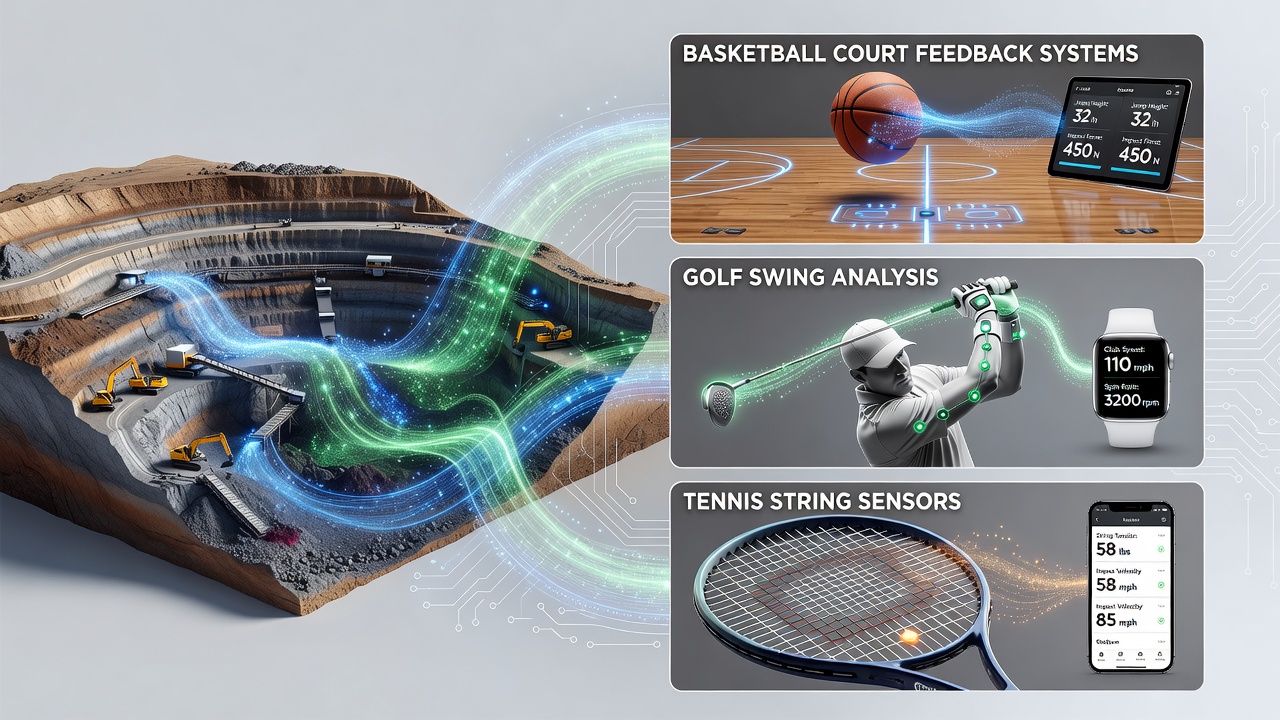
Basketball venues have installed arrays of pressure and optical sensors beneath playing surfaces to measure jump height, landing force, and lateral acceleration. The feedback units incorporate rare earth magnets in their linear encoders, which convert mechanical motion into digital signals with millisecond resolution. League technical reports show that these systems transmit data to sideline tablets, allowing coaching staff to review loading patterns during practice sessions. Because the magnets must operate reliably across temperature swings from arena air conditioning, suppliers select dysprosium-enhanced alloys that maintain coercivity above 150 degrees Celsius.
Integration in Golf Swing Analysis Tools
Golf swing analyzers attach to club shafts or reside inside grip caps, where they record club-head speed, face angle, and impact location. The compact gyroscopes and accelerometers inside these devices use neodymium magnets to generate the reference fields required for precise angular measurement. Equipment testing conducted by the R&A and USGA laboratories confirms that sensor-equipped clubs maintain swing-weight tolerances within 0.5 grams when rare earth components replace earlier ferrite magnets. Data flows wirelessly to smartphone applications that calculate launch conditions and suggest grip or stance adjustments.
Use in Tennis String and Racket Monitoring
Tennis rackets now carry small piezoelectric sensors along the string bed or within the frame to monitor tension loss and impact frequency. Rare earth magnets appear in the micro-actuators that periodically recalibrate string tension during extended matches. Studies published by the International Tennis Federation document average tension drops of 10 to 15 percent after two hours of play, and the embedded sensors provide real-time alerts when thresholds are crossed. The magnets also enable vibration damping modules that reduce frame resonance transmitted to the player's arm.
Supply Chain and Traceability Considerations
Global trade statistics compiled by Natural Resources Canada reveal that over 60 percent of refined rare earth oxides still originate from Chinese separation plants, although new non-Chinese facilities are coming online. Sports equipment brands have begun requiring suppliers to certify the origin of magnetic materials through blockchain tracking platforms. This documentation helps manufacturers demonstrate compliance with emerging due-diligence regulations in the European Union and Canada that focus on mineral sourcing practices. Because each performance sensor contains only trace amounts of rare earths, recycling programs at end-of-life remain limited, yet pilot collection schemes at major tournaments have begun recovering magnets from retired training devices.
Conclusion
The path from mine to sensor spans multiple continents and specialized processing stages before rare earth elements enable the precise feedback loops now common in basketball, golf, and tennis equipment. Continued expansion of separation capacity outside traditional suppliers, combined with incremental improvements in magnet efficiency, supports steady growth in sensor deployment across these sports through the remainder of the decade.